

How do you address the health needs of people that are being persecuted by their own government? Ethnic minorities along the Thai-Burma border are often on the run from government troops, and live in a place that has no formal health care system. Having a positive impact on health is quite a challenge in this setting.
GRI’s response has been to train ethnic Burmese young people to serve as medics. These medics are then provided with the medications they need to treat their own people, no matter where they need to flee.
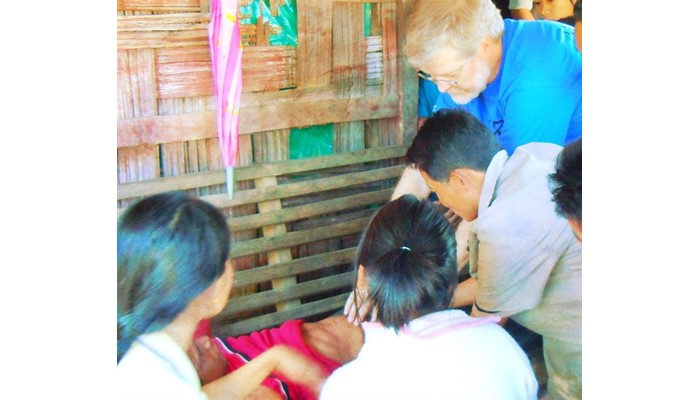
I had the opportunity to participate in one of GRI’s six-month medic training courses along the Thai-Burma border. Conditions were rustic, but the 18 medic students were enthusiastic and engaged. Previous trainers had covered an impressive amount of material, including physical examination skills, adult and pediatric illnesses, gynecologic problems, basic resuscitation and wound care. My task was to teach obstetric care. And I had a week to do it.
Mornings were filled with didactic sessions – short lectures, case studies and hands-on practice with training mannequins. Afternoons were spent at a basic local clinic, reviewing the diagnoses and treatment of patients there. It was sobering to learn that all of the students knew of women who had died as a result of pregnancy complications, and that many of the medics would soon work in areas that were located more than 12 hours from a hospital. We focused on rapid identification and management of post-partum hemorrhage, shoulder dystocia, preeclampsia and obstructed labor.
I’ll never forget teaching the group how to perform a breech delivery. They listened patiently as I explained how to diagnose a breech presentation, and the need to transfer the patient as quickly as possible to a hospital for a likely cesarean section. The medics watched in awe as I used a mannequin to demonstrate a vaginal breech delivery. As the head was finally delivered, there was an audible gasp from the students. “Show us again! Show us again!” they cried out. I reminded them that vaginal delivery of a breech was just for emergency situations. “Yes, yes – just show us again!”
I left the Thai-Burma border confident that this young group of medics had been empowered to have a significant impact on the health of their people. And I’d like to think that they’ve been able to save the lives of some pregnant women and their babies. Maybe they’ve even delivered a breech.
Steve Manock serves as a family physician in rural Tennessee.
GRI’s response has been to train ethnic Burmese young people to serve as medics. These medics are then provided with the medications they need to treat their own people, no matter where they need to flee.
I had the opportunity to participate in one of GRI’s six-month medic training courses along the Thai-Burma border. Conditions were rustic, but the 18 medic students were enthusiastic and engaged. Previous trainers had covered an impressive amount of material, including physical examination skills, adult and pediatric illnesses, gynecologic problems, basic resuscitation and wound care. My task was to teach obstetric care. And I had a week to do it.
Mornings were filled with didactic sessions – short lectures, case studies and hands-on practice with training mannequins. Afternoons were spent at a basic local clinic, reviewing the diagnoses and treatment of patients there. It was sobering to learn that all of the students knew of women who had died as a result of pregnancy complications, and that many of the medics would soon work in areas that were located more than 12 hours from a hospital. We focused on rapid identification and management of post-partum hemorrhage, shoulder dystocia, preeclampsia and obstructed labor.
I’ll never forget teaching the group how to perform a breech delivery. They listened patiently as I explained how to diagnose a breech presentation, and the need to transfer the patient as quickly as possible to a hospital for a likely cesarean section. The medics watched in awe as I used a mannequin to demonstrate a vaginal breech delivery. As the head was finally delivered, there was an audible gasp from the students. “Show us again! Show us again!” they cried out. I reminded them that vaginal delivery of a breech was just for emergency situations. “Yes, yes – just show us again!”
I left the Thai-Burma border confident that this young group of medics had been empowered to have a significant impact on the health of their people. And I’d like to think that they’ve been able to save the lives of some pregnant women and their babies. Maybe they’ve even delivered a breech.
Steve Manock serves as a family physician in rural Tennessee.
